
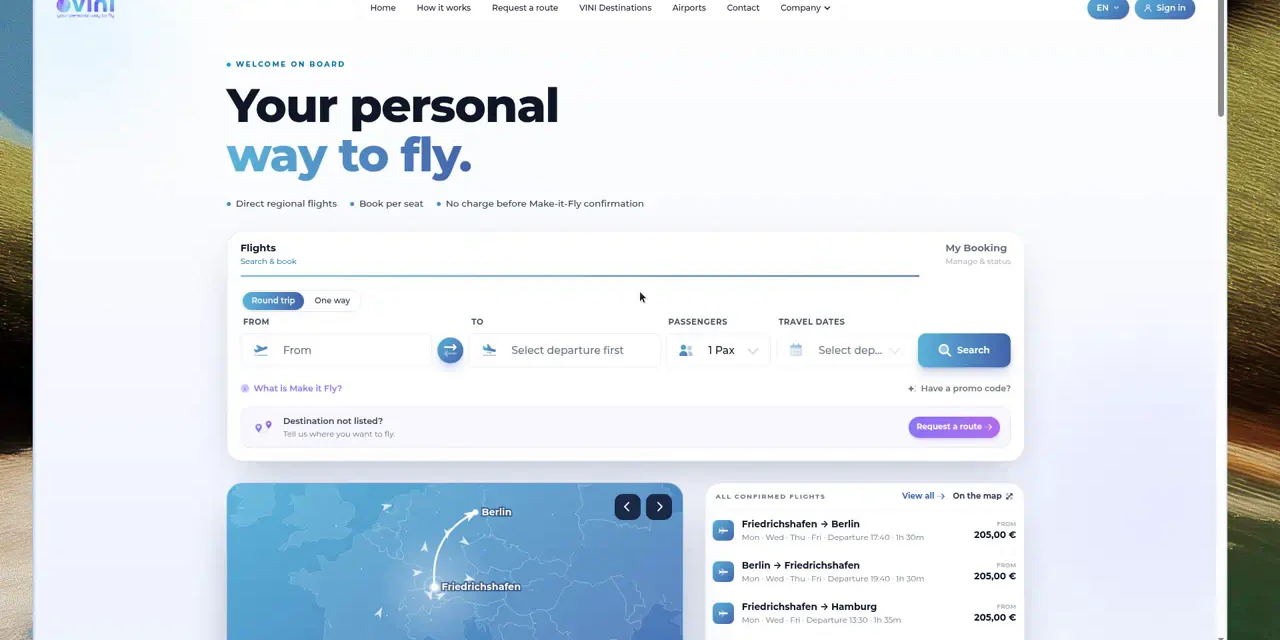

Flyvbird - On-demand Aviation Transport App
Flyvbird is revolutionizing regional aviation in Germany. We connect smaller cities and regions with a flexible, sustainable flight network.
Date
November 2025
Client
Tomislav Lang

Project Overview
Challenges
1- Lack of efficient regional air connectivity: Many smaller German cities are poorly connected, forcing travelers to rely on long, multi-leg train journeys or major hub airports. Flyvbird addresses this gap by enabling direct, short-haul connections.
2- Traditional airline models are not flexible: Legacy airlines depend on fixed schedules, fixed routes, and high passenger volume. Flyvbird had to solve the challenge of building a network that adjusts dynamically to real-time demand without compromising reliability.
3- Operational and logistical complexity: Coordinating aircraft availability, crew scheduling, airport slots, and passenger bookings in an on-demand model required developing smart algorithms and a robust backend capable of processing large amounts of live operational data.
4- Sustainability considerations: Reducing the environmental impact of regional flights was a key challenge. Choosing efficient Tecnam P2012 aircraft and optimizing routes helped minimize fuel consumption and emissions compared to traditional turboprops.
5- User trust and adoption: Introducing a new travel model meant designing a seamless digital experience that communicates reliability, transparency, and ease of use from booking to boarding.
Solutions
1. Building efficient regional air connectivity
We conducted extensive market and route-feasibility analyses to identify underserved city pairs. By integrating real-time demand data and airport availability into our system, we created a flexible network that activates routes only where and when travelers need them. This allowed us to provide meaningful connections without relying on high passenger volume.
2. Creating a flexible, on-demand flight model
Instead of fixed schedules, we developed a dynamic scheduling engine capable of adjusting flight times, aircraft allocation, and routing based on user bookings. This model uses demand forecasting and historical travel patterns to optimize flight deployment — ensuring reliability while avoiding the inefficiencies of traditional airline operations.
3. Managing operational complexity with smart technology
We built an internal platform that centralizes aircraft status, crew assignments, maintenance windows, and airport operations. Automated workflows and algorithmic planning reduce manual decision-making and ensure fast responses to demand changes. This significantly simplified what is traditionally a complex and resource-heavy process.
4. Improving sustainability through design and optimization
We selected Tecnam P2012 Traveller aircraft due to their fuel efficiency and smaller environmental footprint. On top of that, our demand-based routing reduces empty flights and unnecessary emissions. Every operational decision — from aircraft choice to routing — was designed to minimize impact while maximizing service quality.
5. Building user trust with a seamless experience
We focused heavily on clarity and simplicity in the user journey. Transparent pricing, intuitive booking flows, and real-time flight information were introduced to give passengers full control and confidence. Continuous user testing and feedback loops allowed us to refine the experience and address pain points early.
Results
1. More efficient flight network
Thanks to our dynamic scheduling and route optimization, aircraft utilization increased significantly while reducing empty or underfilled flights. This allowed us to offer more direct connections between regional cities without the cost structure of traditional airlines.
2. Reduced travel times for passengers
Users gained access to fast, point-to-point routes that cut travel times by up to several hours compared to rail or hub-based connections. This resulted in higher satisfaction and repeat usage from both business and leisure travelers.
3. Improved sustainability and lower emissions
By deploying efficient Tecnam P2012 aircraft and eliminating unnecessary flight legs, we reduced fuel consumption across the network. Our demand-based model ensures flights only operate where there is real need, lowering the environmental footprint per passenger.
4. AI-powered passenger flow prediction
We implemented machine learning models to analyze booking patterns, seasonal demand, weather impact, and regional mobility trends. These AI systems allowed us to: Predict passenger flow with high accuracy Adjust flight schedules proactively Optimize aircraft allocation Reduce overcapacity and avoid cancellations Improve on-time performance and operational planning This AI layer became a core advantage, enabling smarter decision-making and a more stable network.
5. A seamless and trusted user experience
The improved digital platform led to higher user engagement, better conversion rates, and consistently positive feedback regarding transparency, flexibility, and ease of use.
Client Testimonial
""

Tomislav Lang
Client Information

Tomislav Lang